|
Collaborative
Program of the Faculty of Arts & Science and the Leslie Dan Faculty of
Pharmacy
Pharmaceutical Chemistry
combines knowledge of the biological, medical, and physical sciences in the
study of the scientific aspect of drug therapy. The emphasis is on the
chemical nature of the reactions and interactions involved in drug therapy.
The students will receive a solid background in the aspects of chemistry the
most relevant to drugs: physical, organic, and analytical chemistry. They
will also learn the fundamental aspects of the synthesis, manufacture, use,
and mode of action of drugs.
For more information, please see the program brochure.
We also offer an optional 12- or 16-month internship program to qualified students. This is a project-based, paid employment placement that takes place between the 3rd and 4th years of undergraduate study. It provides the student with an opportunity to apply the knowledge acquired in the first three years of university to private- or public-sector settings. Placements are available in pharmaceutical and biotechnology companies, university research labs, university-affiliated organizations, or government research agencies.
For information about the Internship Program please visit PEY Internship.
Also visit the Pharmaceutical Chemistry Student Union website at http://pcsu.ds4a.com/
|
Undergraduate Office – For general inquiries or to request a program brochure:
L. Chung, (416-978-2162), l.chung@utoronto.ca
Program Director:
Dr. R. Macgregor, (416-978-7332) rob.macgregor@utoronto.ca
PHARMACEUTICAL
CHEMISTRY PROGRAM (B.SC.)
Enrolment in this program
is limited to students with a 2.7 CGPA in the required courses described
below.
Specialist program:
(15.0 courses or their equivalent, including at least one 400-series course)
NOTE: Some of the courses listed below may have prerequisites.
First Year:
BIO 150Y1; CHM (138H1,139H1)/151Y1; MAT 135Y1/137Y1; PHY(131H1,132H1)/PHY(151H1,152H1)
Second Year:
BCH 210H1; (BIO240H1,BIO241H1)/BIO255Y1; CHM (220H1,221H1)/225Y1; CHM 247H1/249H1
Third Year:
CHM 217F1; PCL 201H1; PHC 300Y1; PHC 320H1; PHC 330Y1; PHC 340Y1
Fourth Year:
1. CHM 317H1; PHC 489Y1
2. Two full course equivalents from:
CHM 347H1; CHM 379H1; CHM 410H1;CHM 414H1; CHM 417H1; CHM 427H1; CHM 440H1; PCL362H1; PHC401H1; PHC 331H1; PHC 430H1; PHC 431H1; PHC 451H1; PHC452H1; PHC 460H1; PSL 302Y1
Note that not all of the 400-series PHC courses are offered every academic year.
Back To Top
PHARMACEUTICAL CHEMISTRY COURSES
For Distribution Requirement purposes, all PHC courses are classified as SCIENCE courses .
PHC300Y1 Molecular Pharmacology [78L, 26T]
The molecular basis for the action of drugs is presented based upon the physicochemical nature of the drug and its target.
Prerequisite: CHM 247H1/249H1; (CHM 220H1,221H1)/225Y1; BCH 210H1
PHC320H1 Medicinal Chemistry [39L]
Modern discovery and synthesis of antibiotics, antineoplastics, antiviral and other therapeutic agents.
Prerequisite: CHM 247H1/249H1; BCH 210H1
PHC330Y1 Pharmaceutics [78L, 24T]
The study of the science and technology underlying drug delivery are covered. The properties of different dosage forms and delivery routes are studied with an emphasis on oral and parenteral routes.
Prerequisite: CHM 247H/249H; CHM (220H1,221H1)/225Y1; BCH 210H1
PHC 331H1: Establishing the Bioequivalence of Pharmaceutical Products [39L]
Introduction to human clinical trial design for the demonstration of pharmaceutical bioequivalence of drug products. Students will learn the principles underlying the regulations and methods employed in bioequivalence studies.
Prerequisites: MAT135Y1, BCH210H1, CHM 247H1/249H1,
Pre- or co-requisite : PHC330Y1/PHM224Y
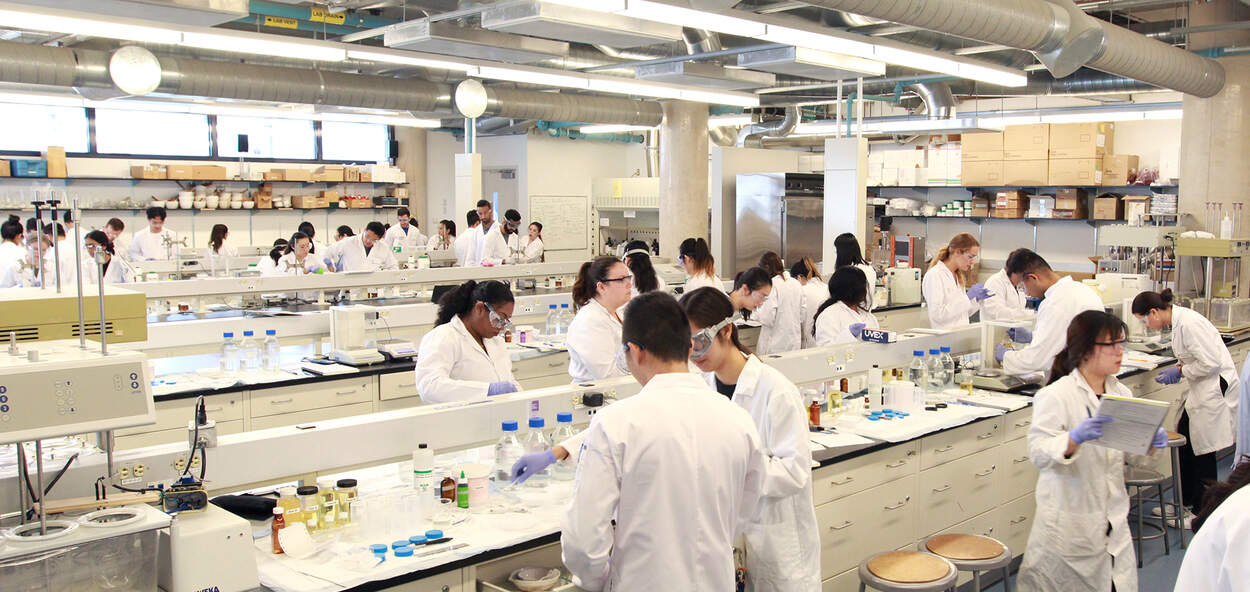
PHC340Y1 Pharmaceutical Chemistry Laboratory [26L, 78P]
The scientific basis and practical techniques relevant to modern pharmaceutical development.
Prerequisite: CHM 247H1/249H1; (CHM 220H1,221H1)/225Y1; BCH 210H1
PHC401H1 Drug Transport across Biological Membranes [26L]
The goal of this course is to provide students with knowledge of the molecular processes involved in drug transport across biological cell membranes with emphasis on their physiological and clinical significance.
Prerequisite: PHC300Y1, Permission of the Instructor
PHC430H1 Recent Developments in Dosage Form Design [26L]
Introduction to controlled drug delivery: Mechanisms and kinetics of controlled drug release. Fundamental theories and mathematical tools for the design of modern dosage forms. Development and applications of controlled drug delivery dosage forms.
Recommended: (PHC330Y1,PHC340Y1)/PHM224Y1, Permission of the Instructor
PHC431H1 Selected Topics in Drug Development [26L]
In-depth discussion of implementation of pharmaceutical sciences in drug development strategies. Students will apply fundamental principles of pharmaceutics and drug delivery to current problems in the pharmaceutical industry.
Recommended: (PHC330Y1,PHC340Y1)/PHM224Y1, Permission of the Instructor
PHC451H1 Radiopharmaceuticals in Diagnosis and Therapy [14L, 14P]
Presents use of radiopharmaceuticals in diagnosis and therapy, emphasizing those used in nuclear medicine procedures studying neurological, cardiovascular, pulmonary, gastrointestinal, haematologic, endocrine and bone pathology.
Prerequisite: (PHC330Y1,PHC340Y)/PHM 224Y1, Permission of the Instructor
PHC452H1 Selected Topics in Radiopharmaceuticals [14L, 12P]
Introduces nuclear pharmacy through the discussion of problems that explain the design, production, analysis, and the clinical use of radiopharmaceuticals. Topics introduced using group discussions and laboratory exercises.
Prerequisites: (PHC330Y,PHC340Y)/PHM224Y, Permission of the Instructor
PHC460H1 Fundamentals of Drug Discovery [26L]
Lectures by scientists from academia and industry, and student seminars based on journal articles dealing with strategies for discovering new drugs for therapy and diagnosis.
Prerequisites: BIO250Y1, PHC300Y1/PHM222Y1, Permission of the Instructor
PHC489Y1 Pharmaceutical Chemistry Research [156P]
This course will provide research experience under the supervision of a Departmental staff member. The goal is to deepen the student’s understanding of the scientific basis and practical techniques relevant to modern pharmaceutical development.
Prerequisite: Permission of the Department and the Project Supervisor
Back To Top
|